

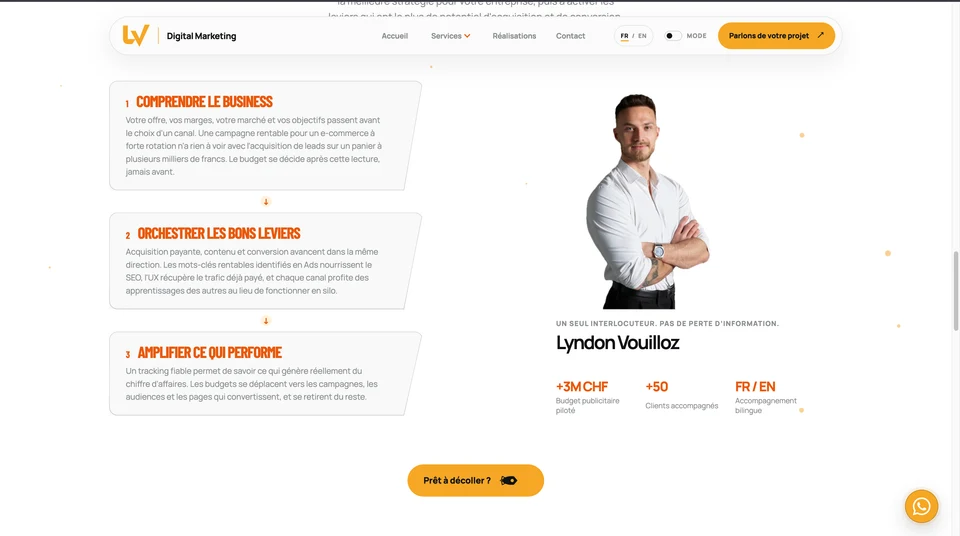
When Lyndon Vouilloz spoke to us about the LV Digital Marketing website, we already knew how he approaches a project. Lyndon is our trusted partner and point of reference for digital marketing. This time, we were building his own presentation tool: a professional website he could share with prospective clients, with an identity that felt right for him and content management suited to his daily work.
The request was straightforward to describe, but it contained two inseparable needs. The website had to explain his business and encourage people to get in touch. It also had to remain useful after development, without requiring Lyndon to contact us for every text change, new image or campaign page. Independence was therefore part of the project from our first conversations.
Start by understanding what he wanted to communicate
We took the time to discuss his business, the people he works with and the way the website would support his first conversations with prospects. A website address sent to a prospective client needs to make useful information easy to find and the company's offer easy to understand. That starting point gave the site a concrete purpose and helped frame both the content and the visual decisions.
Lyndon then shared several website and digital agency references. We studied them together to identify what appealed to him: the atmosphere, the use of colour, particular graphic elements and the way a marketing business was presented. Those references informed our discussions. They helped us put words and examples to a visual direction he already had clearly in mind.
Develop the art direction with Lyndon
Lyndon was particularly interested in colour gradients and elements inspired by references from the market. We worked with that material to develop the visual direction for LV Digital Marketing. The aim was to connect his preferences with the presentation of his business: give the project a recognisable personality while keeping its information and services clear to read.
He helped choose colours and assets throughout this process. That involvement made the collaboration very practical. We could discuss an image, a combination of colours or the feel of a section using specific examples. Aymeric and Romain then translated this direction into the website, bringing the design and development work together.
Independence was part of the original brief
The website had to remain a tool Lyndon could develop himself. Payload CMS lets him manage content and media, add elements and create new pages, including pages for his campaigns.
Connect the website to accessible content management
We designed and developed the website with Next.js and React, using Lenis and GSAP for interface movement. Editorial management runs on Payload CMS. This choice addresses Lyndon's need for independence: he can work on his content and media through a management interface, without changing the website's code.
That independence also applies to the development of the site's editorial structure. He can add new elements and create pages as his business needs them. For a digital marketing professional, this matters: an offer may change, a presentation may need updating and a campaign may call for a dedicated page. The website needs to support those changes over time.
Make room for campaigns
Temporary landing pages are one of the intended uses. They give Lyndon a place to present a campaign, an offer or a specific message, on a page he can create and manage himself. We included this need in the development work so that the website would also support the activities he wants to carry out after launch.
We are not attributing commercial results to the website that we have not measured. The outcome of the project is concrete: Lyndon has a professional presence to share and the editorial tools to develop it. The design and CMS choices address these two complementary needs.
A month of development and a close collaboration
Aymeric and Romain worked on the project over approximately one month of development. Conversations with Lyndon accompanied the website's construction, from the initial references to the choices of colours, visuals and content management. The trust between partners helped us work with direct feedback and clearly expressed needs.
This collaboration reflects the attention we give to the person who will use the website. Their perspective informs the art direction, and their working habits shape the management tools. For LV Digital Marketing, the two come together in a website whose appearance and content Lyndon can make his own.